
Maya Agentic Firewall
One console for the whole fleet:
Enforcement acts on new traffic, and is reversible.
Agents
Tap to enlarge
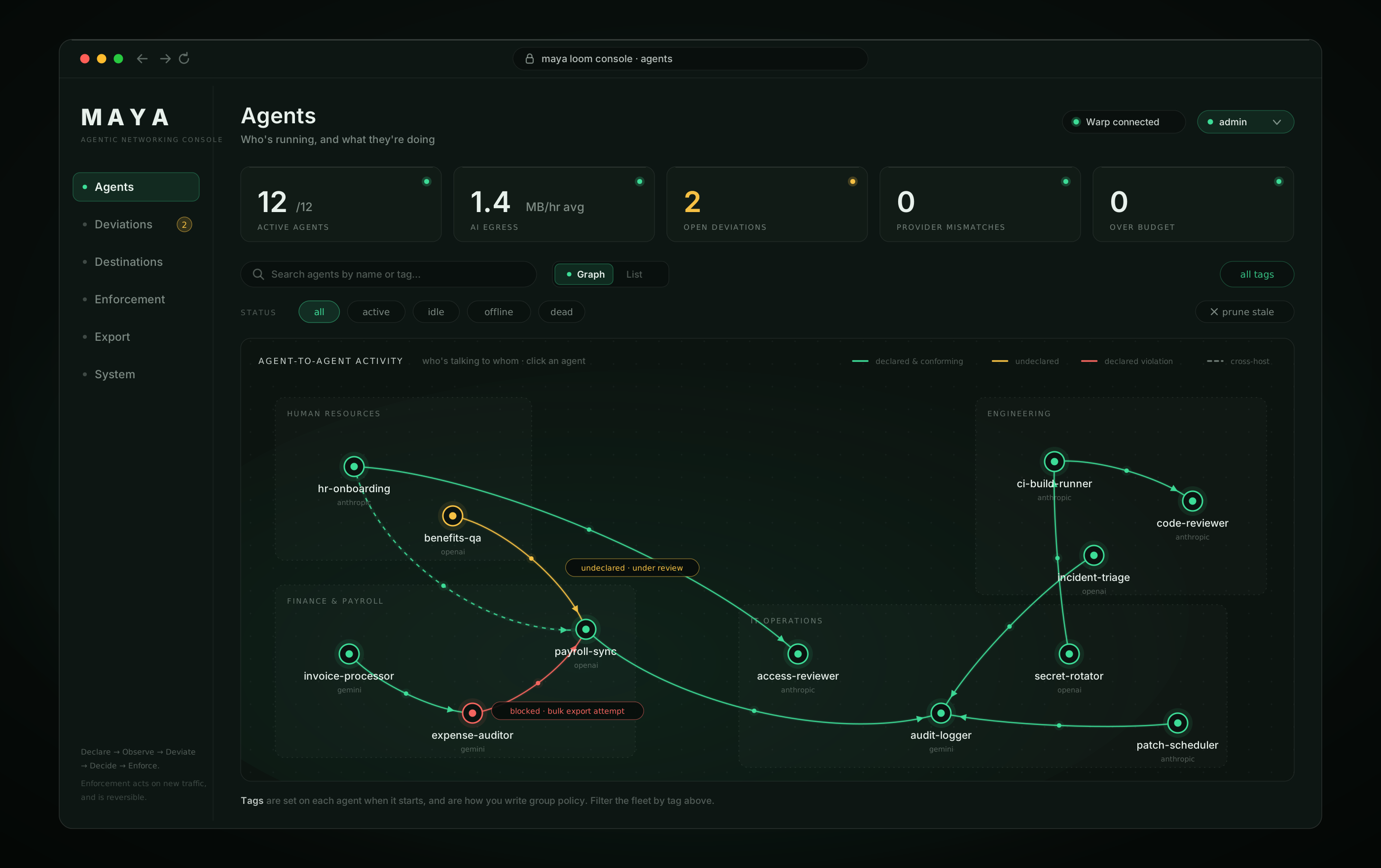
Twelve agents, three zones, one red edge. Every line is attributed to the agent that opened it. Nothing on this board is derived from an IP address.
Maya Policy Control Loop
Network activity
Control layer
Maya
- Declare
- Observe
- Detect
- Judge
- Enforce
Agent-level control
-
Identify your agent fleet
Every agent, and every shadow, becomes visible.
-
Fence your agents
You define an agent's policy mandate.
-
Gather operational evidence
Every connection is tied to the agent that made it.
-
Control agent behavior
Every agent can be judged and acted on precisely.
Step one · Declare
You declare the policy mandate.
Every agent gets stated limits. The same shape as any desk mandate: who, what, where, when, how much.
Who it may talk to
Peers
What it may reach
Providers
Where it may go
Reach
Which way
Direction
When
Window
How long
Lifetime
How often
Rate
How much
Budget
This is the approved-provider list you already maintain, written where it can be measured against.
Step two · Observe
See every agent and its actual relationships.
The mandate defines what should happen. Observation shows what is happening, including activity from agents nobody declared.
-
Agents and context
Reconcile declared agents with workload, runtime, region and time observed on the network.
-
Potential shadow agents
Surface undeclared processes reaching models or agent endpoints for investigation, and enroll them into the fabric.
-
Actual relationships
See the model providers, MCP servers, tools, peer agents and services each agent reaches.
Step three · Detect
Identify the gap between policy and behavior.
For declared limits, Maya produces a named deviation, timestamped and attributed to one agent.
Declared mandate
- Agent
- settlement-recon
- Approved providers
- Anthropic · Azure OpenAI
- Approved peers
- ledger-svc · fx-quote
- Reach
- Internal · external
Observed on the wire
- Agent
- settlement-recon
- Provider
- Gemini
- Peer
- ledger-svc
- Reach
- External
Detected deviation
- Deviation type
- Provider outside mandate
- Agent
- settlement-recon
- Expected / observed
- Anthropic or Azure OpenAI / Gemini
- Context
- AWS us-east-1 · Tue 09:14:22
Evidence produced
Deviation type · Agent ID · Expected · Observed · Workload · Region · Timestamp
Ready for automation
Export the deviation to SIEM, observability or case-management systems.
Step four · Judge
Judge turns evidence and authority into a decision.
Deterministic rules and contextual evaluation determine the verdict and response policy.
Judgment architecture
Evidence
- Detected finding
- Agent mandate
- Behavior and relationships
- External intelligence
Decision authority
- Declared response policy
- External policy engine
- Human review
Judge
Intelligence layer
Deterministic
Explicit rules resolve the verdict
Non-deterministic
Evidence and context shape the verdict
Decision
Verdict
Response policy
What should happen next
Example Large outflow alone → Decision: Zoom + malicious-IP match → Decision: stronger response
Step five · Enforce
Enforce the decision on one agent.
Stop, log, export, inspect or redirect at the wire, without disrupting the rest.
Stop
Drop the agent or block selected flows and agent-to-agent conversations.
Log
Record the activity and allow the connection to continue.
Export
Send the finding and evidence to the institution's existing systems.
Zoom
Increase resolution around one agent and return new evidence to Judge.
Redirect
Send selected traffic to a controlled destination or review path.
Enforcement
Acts on an agent's new traffic. Reversible.
| Agent | Action | Scope | Since | |
|---|---|---|---|---|
claims-triage us-east-1a |
blocking Gemini | new flows to that provider only | 2m ago | Revert |
disclosure-drafter us-west-2b |
monitoring | — | — | Enforce |
The action follows the agent, not the host, workload or shared identity. One agent is controlled. The others keep working.
1 of 5
Onboarding
Maya agent detection
Undeclared agent traffic on a Maya host is detected and auto-enrolled onto the fabric. You get a roster before you get a policy.
Agents
Who's running, and what they're doing
| Agent | Host | Declaration | Tags | Seen |
|---|---|---|---|---|
kyc-screening |
eu-west-1a | 7 of 8 declared | compliance=dora | now |
ledger-core |
us-east-1a | 8 of 8 declared | compliance=sox | now |
forecast-helper
discovered on the wire · enrolled automatically |
us-east-1a | no declaration — nothing to govern | undeclared | 4m |
fraud-scoring |
us-east-1a | 8 of 8 declared | data_class=financial | now |
Reference
The deviation catalog
You declare. Maya observes. Every gap between the two is a typed event with a durable ID, not a log line someone has to go find.
| Type | You declare | It fires when |
|---|---|---|
| PROVIDERS | Model and inference providers this agent may reach | It reaches a provider outside the list |
| REACH | The destination classes it may touch | It leaves its class. The exfiltration signal |
| PEERS | The agents it may talk to | An undeclared A2A edge appears |
| DIRECTIONALITY | Whether it initiates, receives, or both | A receive-only agent starts dialing out |
| EGRESS_BUDGET | A byte ceiling per agent | 75 percent warn, 100 percent critical. Arithmetic, no model in the loop |
| RATE | Connections and bytes per unit time | It goes loud |
| TEMPORAL | The hours it is expected to work | It runs outside its window |
| TTL_LIFECYCLE | How long it should live | It outlives its declared lifetime |
Deviations
Declared, then observed. Every gap, typed.
| Type | Agent | Detail | ID | Age |
|---|---|---|---|---|
| PROVIDERS | claims-triage us-east-1a |
declared anthropic, bedrock — reached openai | dv-8c41f0 | 3m |
| PEERS | invoice-reconciler us-east-1a |
undeclared edge to statement-gen | dv-8c3ea7 | 21m |
| EGRESS_BUDGET | disclosure-drafter us-west-2b |
78% of declared ceiling — warn | dv-8c39b2 | 1h 04m |
| TEMPORAL | treasury-sweep us-west-2b |
ran 02:14 — declared window 06:00 to 20:00 | dv-8c2d40 | 6h 12m |
In your stack
Maya decides nothing you would rather decide yourself
SIEM and SOAR
Deviations stream out of the northbound API. Splunk, Sentinel or XSOAR decides, the action step posts the verdict back, Maya installs it in-kernel.*
Observability
Per-agent flow and deviation telemetry exports as OTLP. Agent attribution lands next to the traces your LLM tooling already collects.*
Bring your own judgment
Point the stream at Open Policy Agent, a Cedar policy, or an agent of your own. Your engine returns a decision, Maya actuates it.†
Export
Where deviations and per-agent telemetry go
Product spec
Maya Agentic Firewall spec
| Form factor | Maya appliance instance in your VPC or VCN. Stitch host shim on each agent host. |
|---|---|
| Datapath | eBPF in the Linux kernel, TC/TCX. Geneve overlay between host and the Maya appliance. |
| Agent declaration | MAYA_AGENT_ID in the process environment. No code change, no SDK, no sidecar. |
| TLS | Never terminated. Never decrypted. No certificate to install, no private key to hand over. |
| Deviation types | Eight. See the catalog above.* |
| Enforcement | Per agent, operator controlled, reversible. Acts on new traffic.* |
| Telemetry out | OTLP to your collector. Datadog, Grafana, Splunk.* |
| Northbound API | Deviation stream out, verdicts in. Driven directly by a SIEM, SOAR or policy engine.* |
| Console | Management plane. Agent roster, A2A conversation graph, deviation stream, enforcement. |
| Control plane | Regional. |
| Clouds | AWS and GCP.* |
Table 2 · Host requirements
Maya currently only supports agents running on a Linux host. See below for detailed Linux distro coverage.
| Architecture | x86_64. |
|---|---|
| Kernel | 4.18 or later. Ships gated at 5.16. |
| Packaging | .deb, .rpm, Helm chart for Kubernetes nodes, tarball for air-gapped installs. |
Table 2a · Platform coverage
| Platform | Base kernel | Status |
|---|---|---|
| RHEL, Rocky, Alma 9 | 5.14 | Supported |
| Amazon Linux 2023 | 6.1 | Supported |
| Ubuntu 24.04 LTS | 6.8 | Supported |
| Ubuntu 22.04 LTS | 5.15 | Supported |
| Debian 12 | 6.1 | Supported |
| RHEL, Rocky 8 | 4.18 | Supported* |
| Amazon Linux 2 | 5.10 | Supported* |
| Bottlerocket, Flatcar, Talos, COS | 5.10+ | Not supported |
| Fargate, EKS on Fargate, Snowpark Container Services | — | Not supported |
Table 3 · Scalability, recommended maximums
| Firewall appliances per VPC or VCN | 1 |
|---|---|
| Hosts per appliance | 128* |
| Appliances per fabric | 8, across VPC, VCN, region and provider boundaries* |
Availability
Where and how to get it
| Clouds | AWS and GCP today.* Maya is built for cloud deployments and runs inside your own VPC or VCN. |
|---|---|
| Status | Limited availability.* Design partner slots are open now. Email contact@mayagentic.com. |
| Marketplaces | Planned.† Cloud marketplace listing is the eventual distribution path. |
| Research Edition | Free for universities, colleges and labs.* Programme details, or email research@mayagentic.com. |
| Pricing | On request. Email contact@mayagentic.com with your fleet shape and we will scope it with you. |
Notes
- *
- Beta-stage detail. Availability, capacity and platform coverage reflect the current beta and are expected to expand.
- †
- Under development. Subject to change. Not a commitment of timing or functionality.
On the roadmap
ABR · Agent-Based Routing†
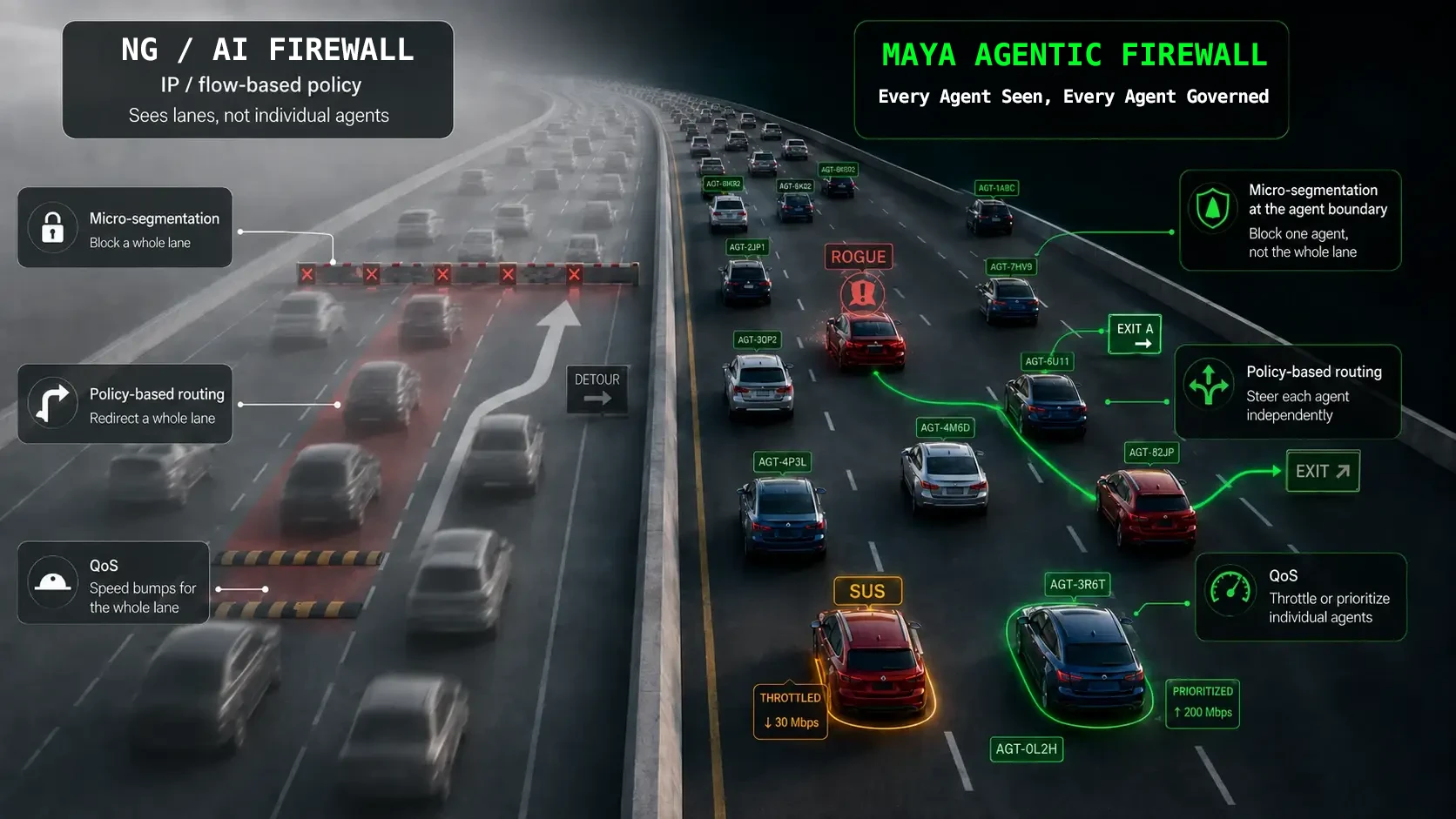
Policy-based routing selects a path from a prefix. ABR selects it from the agent: which region, which provider, which egress point, decided per agent from the declaration you already wrote. Data residency becomes a routing decision rather than an audit finding.
aiQoS, per-agent traffic shaping, is also on the roadmap.
The vision
Make every agent visible. Governable. Accountable.
Design partner, or buy. Tell us the shape of your fleet: how many hosts, which cloud, and what your agents are reaching today.